Brakes
Brakes measured, not guessed
Pads, rotors, calipers and fluid checked with the wheel off, then replaced only where they are worn.
Chapter 01
What your brakes are telling you
Brakes talk before they fail. A high squeal is usually the wear indicator on the pad saying the friction material is nearly gone. A low grinding means metal on metal, and rotors get damaged fast. A pulsing pedal points to a warped or uneven rotor, and a soft pedal suggests air, fluid trouble or a leak somewhere in the hydraulics.
Pulling to one side under braking is another clue, often a sticking caliper or a collapsed hose at one wheel. None of these should be put off. Stopping distance is the one thing on a car you cannot trade away, and a worn brake costs more the longer it runs. If you hear it, feel it or see it, the car is asking for a look.
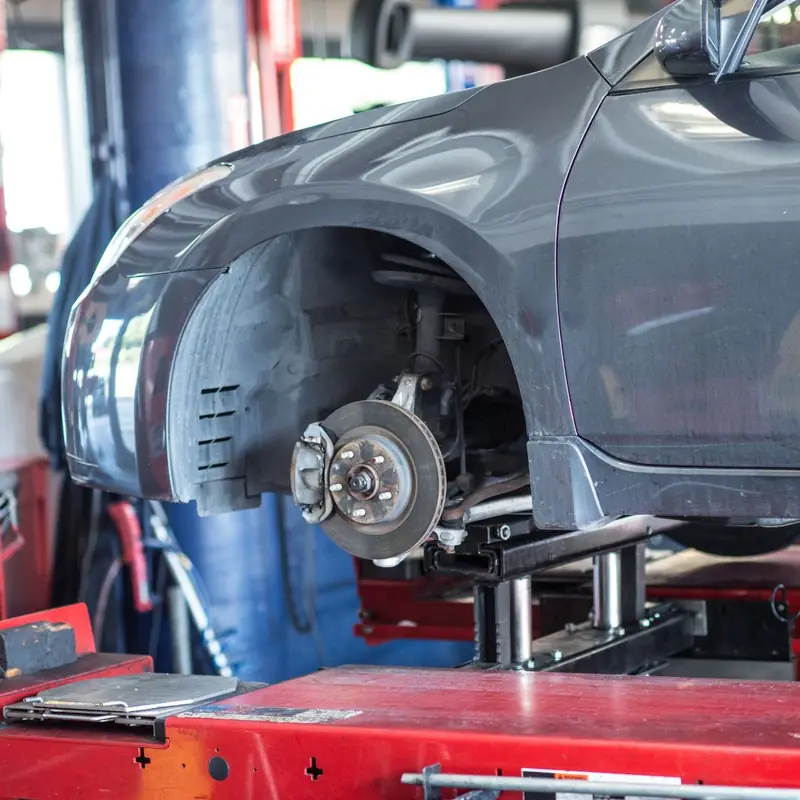
Grey car on a red lift with the wheel off and the brake rotor exposed
Wheels off, everything measured
At our Main St shop we pull the wheels and measure what is there: pad thickness, rotor thickness and surface, caliper movement, hose condition and brake fluid. The photo on this page shows where we start, a car on the lift with the wheel off and the rotor exposed. Measuring tells us what is worn and what still has life, so you are not sold parts the car does not need.
We replace what is worn, then bed in the new pads and road test the car before it goes back to you. You get a detailed quote after the assessment and before the work starts. Tamara Sandoval, on our testimonials page, had her brakes done and was driven home and back while the car sat in the Green Bay bay.
Chapter 03
Salt, slides and the first miles
New pads need a few gentle stops to bed in, so avoid hard braking on the first drives where you can. A slightly different pedal feel in that period is normal while the surfaces mate. A grinding sound, a pulsing pedal or a pull to one side is not, and means the car should come straight back to us.
Wisconsin winters are hard on brakes. Road salt corrodes the caliper slide pins and can seize them, which wears one pad faster than the other. When you swap tires or come in for other work, ask us to check that the calipers still move freely. A few minutes at the wheel can save a set of pads. Call (920) 217-5911 any time something sounds wrong.
Every brake job is done in our own shop at 1644 Main St, Green Bay. Call (920) 217-5911.
Brake diagnosis chart
How a brake complaint gets read
A high squeal when you slow down
The wear indicator is touching the rotor. Pad thickness is measured with the wheel off.
Replace the pads, and check the rotors for scoring.
A pulsing pedal, a shake through the wheel
Rotor thickness and runout are measured, and the caliper slides are checked for sticking.
Resurface or replace the rotors, and service the calipers.
A soft pedal, or a pull to one side
Fluid level and condition, hoses and calipers are inspected for a leak or a stuck piston.
Repair the leak or the caliper, then bleed the system.
A car that pulls or nose-dives when you brake can have a worn part in the front suspension as well as the brakes. If the pedal has gone soft and the car should not be driven, call and we can come with the tow truck.
Other systems we work on at El Mecanico
- Front Suspension ServicesPulls to one side or nose-divesPulling, drifting or nose-diving traced to the exact failed part, one of our main specialties.
- Full Auto DiagnosticA warning light that keeps coming backA full system scan, the codes read and then proven by hand, so you only pay for the repairs you actually need.
- Reliable TowingStuck at the roadsideStranded in Green Bay? We come to the car, and tow it straight to the shop when it needs the bay.