Why Your Vehicle's Suspension and Steering System Matters More Than You Think
The parts that decide whether your car stops straight and steers when you ask are hanging under it where nobody looks.
October 14, 2026 · 4 min read
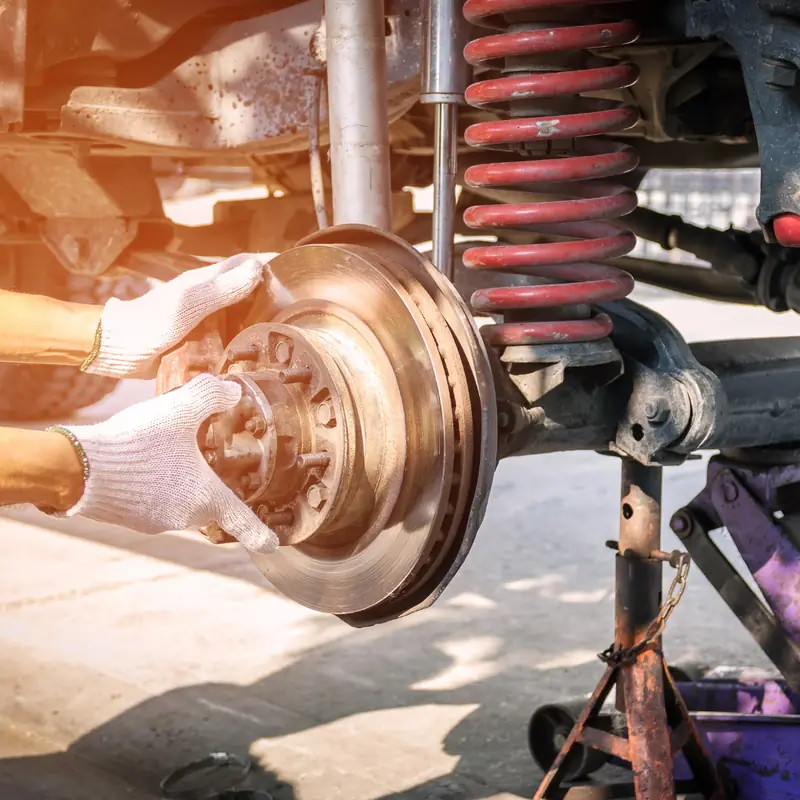
Most drivers watch the oil change sticker and call that maintenance. Meanwhile the parts that decide whether your car stops straight, turns when you ask it to, and stays planted over a pothole are hanging under the car where nobody looks. Suspension and steering take a beating every mile, and they wear so slowly that you adjust to the decline without noticing. The rattle you stopped hearing last spring is still there. It just became normal.
Your suspension is managing physics every second
Every time you brake, accelerate, turn or hit a rough patch, weight moves around the car. Brake hard and the nose dips because weight shifts forward. Step on the gas and weight slides back, taking load off the front tires, which are the ones doing your steering. Take a corner and the outside of the car loads up while the inside unloads.
A healthy suspension keeps that movement controlled, so the tires stay pressed to the pavement. A worn one lets the weight slosh around, and the tires pay for it with lost grip at the exact moment you need it. That's why suspension condition ties directly to how well you can avoid a collision, not just how smooth the ride feels.
The parts that wear, and what they feel like
Shocks and struts don't hold the car up. The springs do that. Shocks and struts control what the springs do after a bump, slowing the rebound so the car doesn't keep bouncing. When the seals and valves inside wear out, the car floats, dives under braking and takes too long to settle. Often there's no leak to see, so the wear can sit there for a long time.
Control arms tie the wheels to the car, and the rubber bushings in them keep everything tight and aligned. When bushings go soft, the steering gets vague, the car drifts or pulls, and you catch yourself correcting the wheel just to hold a straight line. Tire wear turns uneven.
Ball joints are the pivots that let a wheel steer and move up and down at the same time. A worn one might give a faint clunk over bumps, or nothing at all, and most are sealed so you can't peek inside. A joint that finally lets go can drop the wheel out of position and take your steering with it. Tie rods connect the steering to the wheels. A little play in them makes the car wander, and a failed one can end steering control altogether. Sway bar links are the noisy ones: clunks over bumps or in turns, and a car that leans more than it should.
What neglect does to everything else
Worn suspension chews up tires no matter what brand you buy. Bouncing causes cupping, loose tie rods cause feathering, and bad alignment wears the edges. Replace the tires without fixing the cause and you're just buying them again on a shorter schedule.
Brakes lean on the suspension too. If tired shocks let the nose dive, the front brakes take more of the work, the rotors run hotter, and the back wheels do less than they should. New pads on top of worn struts can't give you the stopping performance you paid for.
Newer cars add one more wrinkle. Lane keeping, adaptive cruise and automatic braking use sensors aimed at set angles. A car that sags changes where they point, which can mean false warnings or a system that reacts late.
Old habits that hide real problems
- The bounce test. Pushing down on a bumper tells you very little about modern gas-charged shocks, which can pass that trick and still fail on the road.
- Alignment first. An alignment on top of worn parts won't last. The moment you drive, loose components shift and the angles drift. Fix the worn parts, then align.
- Ignoring the season. Potholes, gravel, road salt and freeze and thaw cycles all speed up wear. Salt corrodes, potholes bend things you can't see, and cold stiffens rubber until it cracks.
If you drive Green Bay roads through a Wisconsin winter, your suspension has seen all three. A look underneath once the roads clear beats finding out the hard way.
What a real inspection looks like
A glance under the car won't do it. A proper suspension inspection has three parts. First, a road test: the technician drives it at different speeds, over bumps and through turns, listening and feeling for vibration, noise and steering that doesn't track. Second, a steering check with the car parked on the ground, because play in tie rods, ball joints and steering rack mounts can hide once the wheels are in the air. Third, a lift inspection with hands on every part.
- Ball joints and control arm movement
- Bushing condition and flexibility
- Shock and strut leaks or internal wear
- Sway bar links and springs
- CV boots and wheel bearings
When parts do need replacing, shocks, struts and control arms usually go in pairs so the two sides match, and the hardware around them gets a look so the next failure isn't already waiting. Then alignment, so the repair holds and the tires wear evenly.
Get it looked at before it gets loud
If your car pulls, drifts, dives when you brake, clunks over bumps or wears out tires faster than it should, bring it in. El Mecanico Auto Repair does front suspension work in-shop at 1644 Main St in Green Bay. The goal is to find the part that has actually failed, so you're not paying for a pile of guesses. Call (920) 217-5911 to book a time.
El Mecanico Auto Repair, (920) 217-5911
Call (920) 217-5911More articles
Check Engine Light On? What It Means and What to Do Next
The light tells you something is off. It doesn't tell you which part to buy.
Car Overheating on the Road: What to Do First, and When to Call a Tow
Overheating can wreck an engine in minutes if you keep driving, so the first few decisions matter most.